Event Recap: Author Series: Africa’s Next Political Generation

October 8, 2026 | Virtual Program
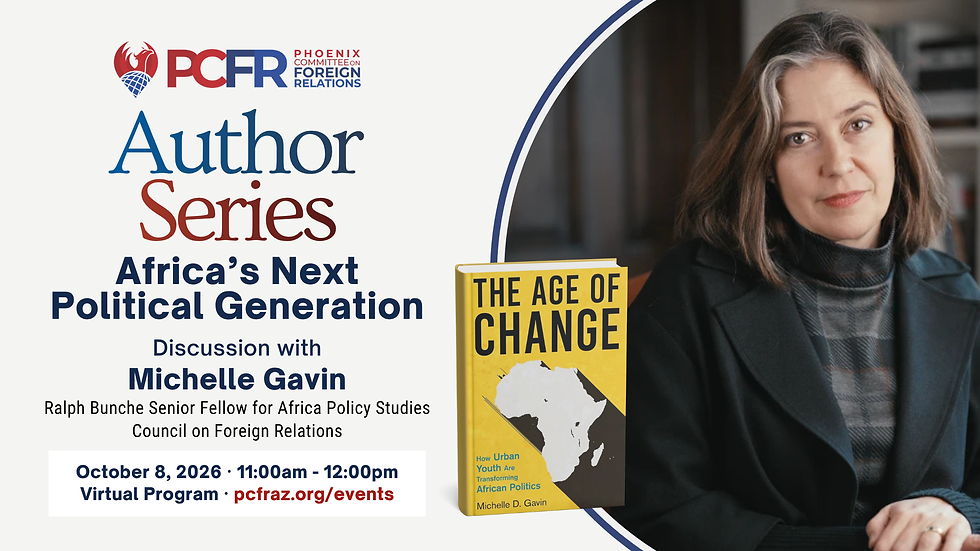
Africa is undergoing a profound political transformation, driven by the convergence of three powerful forces: a rapidly growing youth population, accelerating urbanization, and expanding digital connectivity. On October 8, the Phoenix Committee on Foreign Relations (PCFR) welcomed Michelle D. Gavin, Ralph Bunche Senior Fellow for Africa Policy Studies at the Council on Foreign Relations (CFR) and former U.S. Ambassador to Botswana, for a virtual discussion exploring how these trends are reshaping African politics and challenging long standing political structures.
Drawing on her new book, The Age of Change: How Urban Youth Are Transforming African Politics, Gavin examined the emergence of a politically engaged generation whose expectations and priorities increasingly diverge from those of the leaders and ruling parties that have governed much of the continent for decades.
A Demographic Transformation with Political Consequences
Gavin began by highlighting the extraordinary scale of Africa's demographic transformation. In more than a dozen African countries, over 60 percent of the adult population is under the age of 25. While demographic trends vary significantly across the continent, the sheer size of this emerging generation creates the potential for political change on an unprecedented scale.
These demographic shifts are unfolding alongside rapid urbanization and the widespread adoption of digital technologies. Together, they are enabling young Africans to organize, exchange information, and mobilize around shared grievances in new ways. At the same time, growing urban populations are placing mounting pressure on governments to deliver essential services, economic opportunities, and accountable governance.
One particularly significant challenge is employment. In countries such as Nigeria and Kenya, large numbers of young people are entering the labor force without sufficient opportunities for formal employment. Gavin emphasized that the demand for dignified work is central to understanding contemporary political discontent and the expectations younger generations have of their governments.
Challenging Entrenched Leadership and Political Narratives
A central theme of the discussion was the striking contrast between Africa's exceptionally young populations and its often remarkably long-serving political leadership. Across parts of the continent, presidents have remained in power for decades, while ruling parties have maintained their dominance across generations. Gavin described how this political stasis, which has characterized many African political systems since the end of the Cold War, is increasingly coming into tension with profound demographic and social change.
In countries such as South Africa, Zimbabwe, and Uganda, ruling parties and leaders have long drawn legitimacy from their roles in independence and liberation struggles. Yet for younger generations with no firsthand memory of these movements—and in many cases, no experience of political leadership other than the incumbent party or president—such historical credentials increasingly carry less political weight.
Gavin described how this generational divide is opening space for new political movements and demands for greater accountability. However, she cautioned against assuming that generational change will necessarily produce democratic outcomes. Some military regimes have themselves adopted liberation rhetoric to justify their authority, illustrating how established political narratives can be repurposed rather than displaced.
Youth Mobilization and the Prospects for Democratic Change
Turning to specific country examples, Gavin explored how youth-driven political mobilization has produced markedly different outcomes across the continent.
In Senegal and Zambia, strong youth political engagement helped propel opposition candidates to electoral victories in 2024 and 2021, respectively, illustrating the growing influence of younger generations in challenging established political leadership. In Kenya, youth-led protests have highlighted widespread frustration with economic conditions and government responsiveness.
Sudan, by contrast, illustrated the limits of popular mobilization when political institutions and powerful entrenched interests prevent democratic aspirations from translating into durable political change.
Gavin emphasized that even successful political transitions do not automatically resolve the underlying grievances that fueled demands for change. Newly elected governments often face severe fiscal constraints, limited administrative capacity, and high public expectations. Delivering tangible improvements in employment, public services, and living standards remains an essential test of political legitimacy.
Implications for U.S.–Africa Relations
The conversation concluded with a discussion of the implications for U.S. engagement with Africa amid intensifying international competition for influence on the continent.
Gavin expressed concern about the consequences of reductions in U.S. foreign assistance, particularly the drawdown of USAID programs, while examining Washington's growing emphasis on commercial diplomacy.
Although stronger trade and investment relationships offer important opportunities, Gavin stressed that U.S. engagement must be responsive to African priorities. In particular, she argued that policies focused on commercial partnerships must also address the urgent demand for meaningful employment among Africa's expanding youth population.
Ultimately, the discussion underscored that Africa's political future will be shaped not simply by demographic change, but by how governments respond to the aspirations of a new generation. With young Africans increasingly challenging entrenched leadership, established political narratives, and longstanding patterns of governance, understanding their priorities will be essential for policymakers, international partners, and anyone seeking to understand the continent's evolving global role.